Summer Color by Code Worksheets: Math Practice Made Fun
When the days grow longer and the energy in the classroom shifts toward summer excitement, keeping young learners engaged in foundational math skills can feel like a challenge. This is precisely where thoughtful, themed resources prove their worth. The Summer Color by Code Worksheets offer a practical and visually appealing solution for educators and parents looking to blend essential math fact fluency with creative, hands-on activity.
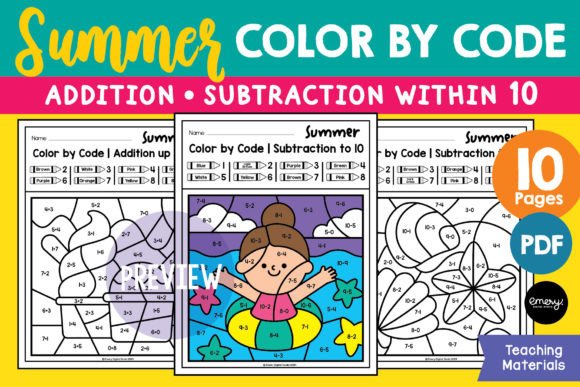
This resource consists of 10 distinct pages, carefully designed to practice both addition and subtraction with sums and differences up to 10. The concept is straightforward: students solve a series of math problems within a picture. Each answer corresponds to a specific color. By correctly completing the equations, children reveal a vibrant summer-themed image. It’s a method that transforms repetitive practice into a rewarding discovery, building confidence alongside computational speed.
Visual Design and Practical Appeal
From a design perspective, these worksheets are intentionally created for maximum accessibility and utility. The pack is delivered as a black and white PDF, which is a significant practical advantage. It eliminates concerns about color ink costs or printer availability, making it an easy resource to distribute and use in any setting—whether in a school, a tutoring center, or at home. The clean line art ensures that the coloring portion is satisfying and that the hidden picture emerges clearly once filled in.
The 8.5x11 inch dimensions conform to standard letter size, ensuring seamless printing without adjustments. The overall aesthetic is friendly and approachable, featuring summer icons that resonate with children. This isn’t just a worksheet; it’s a mini-project. The act of coloring engages fine motor skills and allows for a brief mental break from calculation, which can actually help solidify learning. For the educator or parent, the included answer keys streamline the process, saving valuable time during preparation or review.
Beyond the Classroom: Applications for Various Professionals
While the primary audience is teachers and parents, the underlying principle of the Summer Color by Code Worksheets offers insight for other professionals. Consider the content creator or blogger in the education niche. A resource like this provides tangible value to share with an audience, establishing authority and helpfulness. A small business owner creating activity kits for children could incorporate these sheets as a high-value, low-cost component. The digital files are ready to download and print, offering flexibility for last-minute planning or customized activity packets.
The design of such educational materials also touches on broader principles of visual hierarchy and user experience. The layout must guide the child’s eye from the problem to the answer key to the coloring section without confusion. This is a microcosm of good editorial design—ensuring information is presented in a logical, intuitive flow. The success of these worksheets lies in their ability to make the learning objective (math fluency) the clear focus, while the coloring element serves as an engaging reward system.
Building Foundational Skills with Engaging Tools
The core value of this resource is its dual focus on problem-solving skills and early cognitive benefits. Repetitive practice is essential for mastering math facts, but it doesn’t have to be tedious. By embedding practice within a creative task, children are more likely to persist. They learn to check their work—a mistake means the color won’t match the intended image—introducing a natural feedback loop.
For those managing a classroom or homeschool environment, resources like the Summer Color by Code Worksheets are indispensable design assets. They save hours of creation time while providing a polished, effective product. The fact that it is a non-editable PDF ensures consistency; what you download is exactly what you get, protecting the integrity of the original work from Emery Digital Studio. This reliability is crucial when planning lessons or activities.
Incorporating this type of resource into a summer learning plan can help mitigate the “summer slide,” keeping skills sharp in a low-pressure format. It’s a practical application of design thinking to education—understanding the user (the child), the environment (summer, home, school), and the goal (math fluency), then creating a solution that aligns all three. The result is a resource that is not only useful but genuinely enjoyable to use.